Tuesday, April 10, 2012

Psycho

Personal Rating Scale: I would give this movie an 8 out of ten 10 stars. The film was exciting to watch because one never knew when someone would get killed. I would advice not having the music too loud the first time viewing; it startled many of us especially the second stabbing.
Psycho, directed by Alfred Hitchcock is an American black and white horror movie produced in 1960. Alfred Hitchcock was unique in his directing. I personally enjoyed the film because it was quite unpredictable. I knew as I was watching that Norman Bates was an odd character and was probably somehow involved in the killing. "Oh, we have 12 vacancies. 12 cabins, 12 vacancies" (Norman Bates). If no one went to his hotel, why would he keep it running? He was a psycho. He was very attached to his mother and in his mind he acted out both himself and his mother. When his mother's side would take over, she would become an overprotective mother and kill people. The reason she (actually Norman Bates) killed Marion was because Norman felt attracted to her and Norman's mother side did not like that.

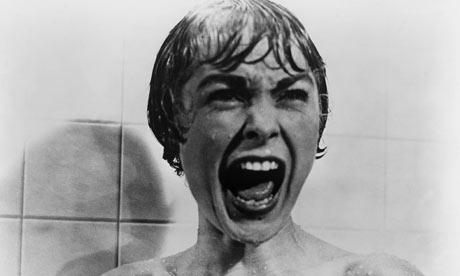
Another aspect of the movie was how the main character in the beginning of the movie had suddenly died as she was taking a shower. It was so unexpected because in almost all movies the main character, or the character that the camera is mostly on, doesn't suddenly die in the middle of the movie. It was very unexpected and it left the rest of the movie more entertaining to watch and try to figure out the mystery on who was behind the killing.
Another interesting thought is how minor the thievery of forty thousand dollars seemed compared to Norman Bates and his psycho brain. The beginning and the thievery and run away of Marion could have been its own movie without Norman Bates. It was kind of like a story in a story. I was expecting the movie to end with Marion trying to resolve her crime and return to Phoenix. She never had the chance to. "And the forty thousand dollars? Who got that?" ( Sheriff Al Chambers).

Special Thanks to:
http://www.imdb.com/title/tt0054215/quotes

Thursday, April 5, 2012

Ben Hur

File:Ben-Hur (Klaw & Erlanger) crop.jpg
Socractic Discussion on Ben Hur can heard by following this link:
http://www.youtube.com/watch?v=451lw-UlCqY

Citzen Kane


Personal Rating Scale: I would give this film a 7 out of 10 star. The film was entertaining to watch because it kept the viewer trying to find the missing pieces to the film such as the meaning of “Rosebud”.

Citizen Kane directed by and starring Orson Welles, is a drama/mystery that came out in 1941.The movie contains a lot of symbolism and shows viewers that a man can waste his life trying to regain his childhood. Citizen Kane is chosen by critics as their number one choice. As I watched the movie, I had the question in the back of my mind: Why do critics choose it as their number one choice? I think the reason critics like it so much is because of how the movie was told. The movie was basically a bunch of reporters interviewing people looking for the meaning of the word “Rosebud”. It was not just one person’s view on who Mr. Kane was but it was of many people’s views. The movie tells a lesson, shows symbolism, and is told in a different way than most movies.

The movie begins and viewers are immediately shown the death of an extremely wealthy man named Charles Foster Kane. As the movie continues, I was not in question of how he died but I wanted to know who he was. Early on in the movie, viewers see Kane taken from his parents. The movie continues on showing how he amassed all of his wealth as a newspaper tycoon. Mr. Kane was never interested in money. His ambitions in life were to regain what he lost from his childhood.

The symbol of rosebud is shown at the end of the movie and it reveals that the name of the sled from his childhood. He was taken away from that sled and his parents at a young age and was constantly struggling to obtain it throughout his life. This struggle led to many selfish acts. He was a man who believed in equality and he wanted to help the poor people. The thing that destroyed him was he wouldn’t carry his beliefs out and never gave anything away. He only looked to buy things for people so they would give him their love.

Memorable Quotes:

“Harvard, Yale, Princeton, Cornell, Switzerland... he was thrown out of a lot of colleges.” –Bernstein

“You know, Mr. Bernstein, if I hadn't been very rich, I might have been a really great man.” –Charles Foster Kane

”You're right; I did lose a million dollars last year. I expect to lose a million dollars this year. I expect to lose a million dollars *next* year. You know, Mr. Thatcher, at the rate of a million dollars a year, I'll have to close this place in... 60 years. -Charles Foster Kane

“He happens to be the president, Charles, not you.” –Emily

“Love! You don't love anybody! Me or anybody else! You want to be loved - that's all you want! I'm Charles Foster Kane. Whatever you want - just name it and it's yours! Only love me! Don't expect me to love you.” –Susan Alexander

“You don't care about anything except you. You just want to persuade people that you love 'em so much that they ought to love you back. Only you want love on your own terms. Something to be played your way, according to your rules.” –Leland

Special Thanks to:

http://www.imdb.com/title/tt0033467/quotes

Friday, March 23, 2012

Gone With The Wind


Personal Rating Scale: I would give this movie a 7 star out of 10. It is a great American movie but is rather boring at times.


            Gone with the wind, directed by Victor Fleming, is a movie about the civil war in the point of view of the South. The best guess for the movie’s genre is a classic, drama, and romantic. This movie makes the North, or the Yankees, look like the “bad “guys. It shows how tough it was to live in the South at the time of the Civil War largely because it was where most of the fighting was. This movie had good characters, exciting rising action and climax, and was an extravagant movie that showed the Civil War in the eyes of the South.
File:Poster - Gone With the Wind 01.jpg
As seen in Gone with the Wind, the protagonist Scarlett deals with many hardships. She struggles with hunger and swears she will never be hungry again. “As God is my witness, as God is my witness they're not going to lick me. I'm going to live through this and when it's all over, I'll never be hungry again. No, nor any of my folk. If I have to lie, steal, cheat or kill. As God is my witness, I'll never be hungry again” (Spark notes Editors). This quote by Scarlett reveals that she is lacking hunger during the Civil War. Other main characters include Ashley, who Scarlett loves at first, and Rhett Butler who she loves at the end.

The rising action in the first part of the movie is Scarlett having to confront the fact that the man she loves, Ashley, is married to someone else. Not only that, but the Civil War was starting. The climax being Scarlett returning to Tara finding her mother dead and her planation looted. The falling action is Scarlett swearing she will never go hungry again.

In part two, Scarlett begins to rebuild Tara and had a troublesome relationship with Rhett Butler. The climax in part two is Scarlett finally realizing she loves Rhett Butler and she rushes home to tell him. A famous quote by Rhett Butler: “My dear, I don’t give a damn” (Spark notes Editors).He says this after Scarlett tells him of her love but Rhett is so sick of how she treats that he doesn’t care. The movie ends and Scarlett starts to think of ways to get him back.

This movie definitely showed how difficult it was for the South during the Civil War. Once the South got past their negligence and ignorance about slavery and came back to the Union, America grew stronger. Gone with the Wind is a great mark of American History.

Special thanks to:

SparkNotes Editors. “SparkNote on Gone with the Wind.” SparkNotes.com. SparkNotes LLC. 2003. Web. 22 Mar. 2012.

http://www.imdb.com/title/tt0031381/quotes